How CivicsPath actually makes you ready.
Three small mechanisms that compound over six weeks. Each one is described honestly below, including what it isn't.
Five minutes to find your starting line.
We ask you 12 questions across the 3 categories. The result tells us which themes you already know and which need the most work.
The diagnostic samples each USCIS category proportionally: four questions on American Government, four on American History, four on Integrated Civics. We mix easy and hard items so the result reflects real readiness, not luck.
Your answers feed straight into FSRS as initial difficulty ratings, so day-one cards are already calibrated to where you actually are, not where a generic curriculum assumes you start.
It is not a placement test. There is no pass or fail. You can retake it any time, and the result re-tunes the schedule the same day.
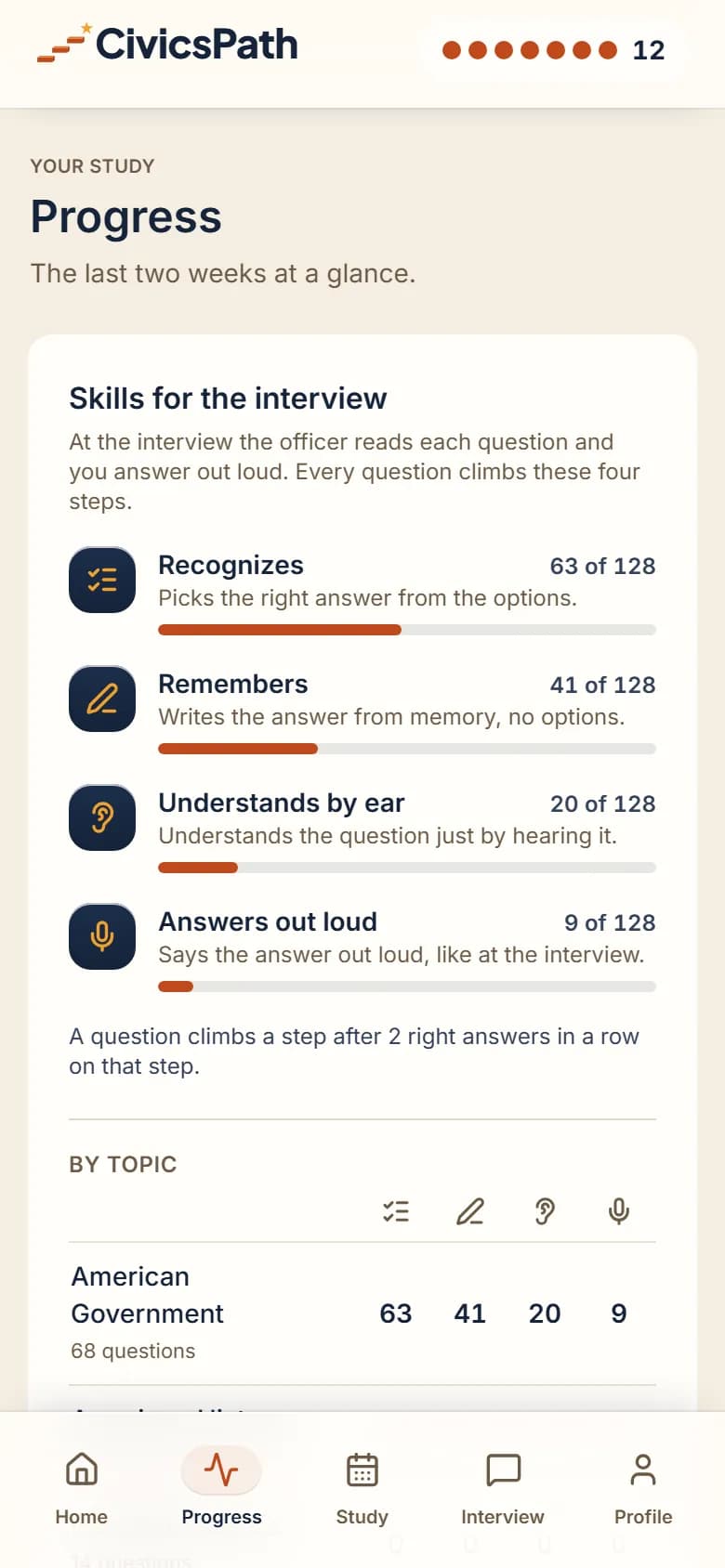
Reviewing what you almost forgot, on the day you'd almost forget it.
This is the same algorithm Anki uses, in production. It's the only thing in this app that genuinely beats cramming.
Spaced repetition is built on the forgetting curve, a 1885 finding that we lose new information fast at first, then slower, then very slowly. If you re-encounter a fact at the moment you're about to forget it, the curve resets and flattens. Do that a handful of times and the fact stays for years instead of days.
FSRS (Free Spaced Repetition Scheduler) is the algorithm we use. It's the modern, data-driven successor to the SuperMemo / Anki SM-2 family, open source, peer-reviewed, and tuned on millions of real review logs. We picked FSRS because it predicts the next-review date more accurately than older schedulers, which means fewer reviews for the same retention.
In practice it feels like 5 cards a day, about 3 minutes. Some days the queue is empty. Some days a long-buried fact comes back for one last review and then leaves you alone for six months. You don't plan it; the schedule does.
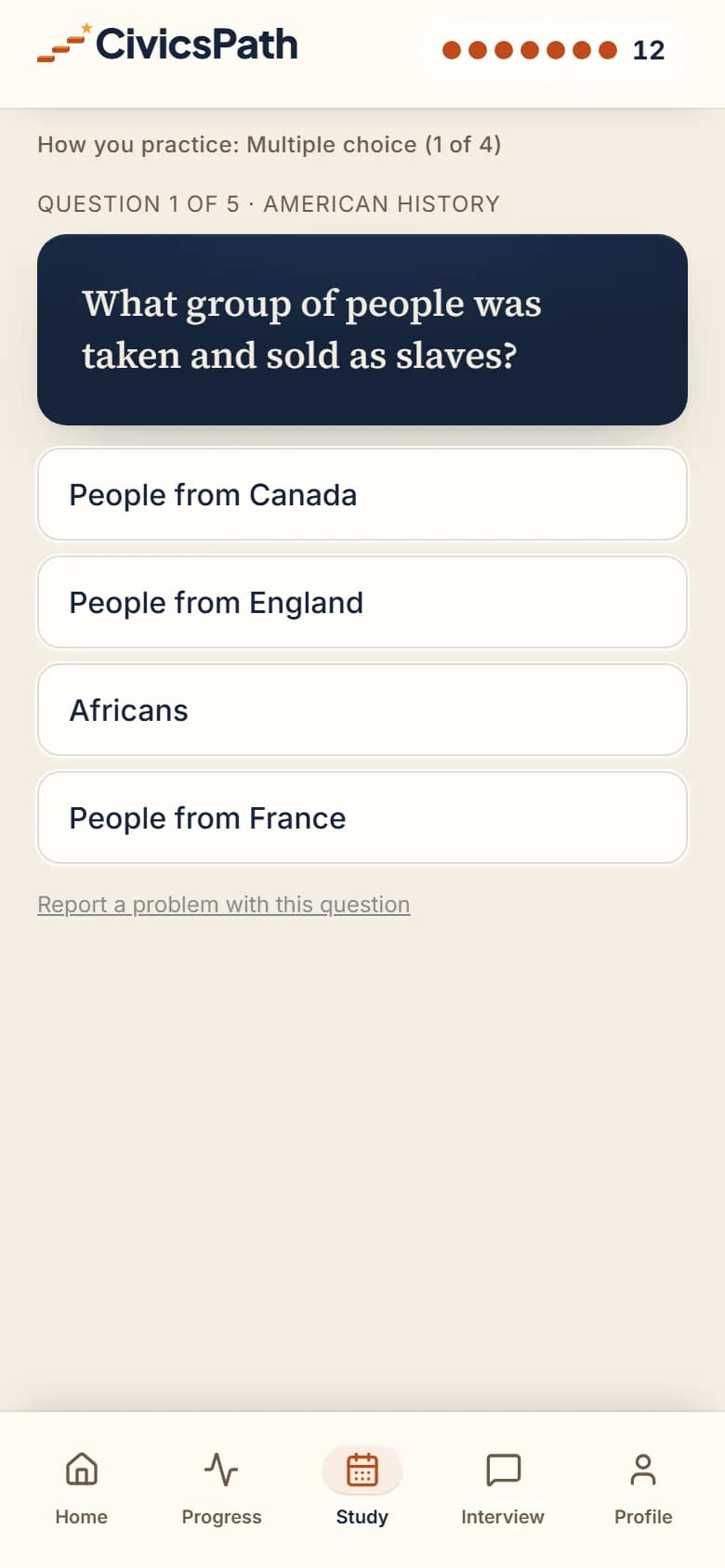
Practice the conversation, not just the facts.
The interview asks officer-style questions about your own life, not multiple choice. We rehearse those, with adaptive difficulty.
The N-400 interview is four sections in one sitting: biographical (your application answers, in plain English), civics (10 of the 128 questions, asked aloud), reading (one sentence), and writing (one sentence dictated). Most applicants over-prepare for civics and under-prepare for the conversation around it.
Our mock simulates the whole encounter. You pick an officer archetype, friendly, neutral, brisk, and we lazily capture the parts of your N-400 that drive biographical questions (employment, addresses, travel, family). The session uses your real answers, so the rehearsal sounds like you, not a script.
Run one whenever you feel ready. Spacing them out helps: a mock every week or two lets your civics knowledge settle through FSRS and gives you something concrete to react to in between, while doing one every day tends to turn into rote performance.
The same voices you practice with.
The whole interview, not just the civics quiz.
Most apps drill you on the civics questions alone. The real USCIS naturalization interview has four parts, and we rehearse all of them with you.
Small talk
The officer chats about the weather, your trip in, and how long you waited. It sounds casual, but it is a gentle check of your spoken English.
Your N-400 background
The officer goes through your actual application, including the tricky eligibility questions, and may ask you to explain a term you just used.
Civics questions
The officer asks questions from the official civics set and accepts any correct listed answer.
The only part most apps cover
Reading and writing
You read one sentence aloud and write one sentence down. Then the interview is over.
What CivicsPath is not.
- Not legal advice. We're not attorneys, paralegals, or USCIS representatives.
- Not a guarantee. The test depends on test-day variables we don't control.
- Not a leaderboard. No streaks shaming you for missing a day.
- Not a bot you negotiate with. The mock interview gives feedback, not approval.
Keep reading
Pricing · $19.90/mo, $149/yr, $199 lifetime
One global price across English, Spanish, and Portuguese. 7-day no-card trial.
All 128 USCIS civics test questions (free)
The official 2025 question pool with answers, audio, and historical context. No signup.
Free 20-question mock test
A no-signup, no-card practice round in your browser. Same format as the real interview.
Free resources for citizenship teachers
Printable question sheets, a vocabulary list, and a mock-interview classroom script for ESOL and citizenship instructors.
See if it works for you.
Free 7-day trial. No card required.